Home › Blog › Can old photos be restored
Can old photos be restored? A damage-by-damage answer
Almost always, yes. Fading, scratches, tears, and stains can be repaired digitally, often in one tap, and even water-damaged or moldy prints can usually be saved if you act within 48 hours. The answer for your photo depends on its damage type, so this guide gives a verdict for each, including the losses no tool can reverse.
One rule before anything else: capture it now
Whatever is wrong with your photo, its safest day is today. Left in a drawer, a print keeps fading while any mold on it keeps spreading, and each handling adds a fingerprint. So before you do anything else to it, photograph it exactly as it is. A phone photo taken by a window covers every fix described below.
Daylight from a window works better than flash, which bounces a white blob off glossy paper. Get square on to the print and fill the frame. If the print is curled or brittle, shoot it as it lies rather than forcing it flat, because a skewed capture is easy for software to straighten and a print that cracks while being flattened is damaged for good.
Once the picture is captured, almost nothing below is urgent anymore.
The two exceptions are water and mold, which keep working on the print
until you deal with them.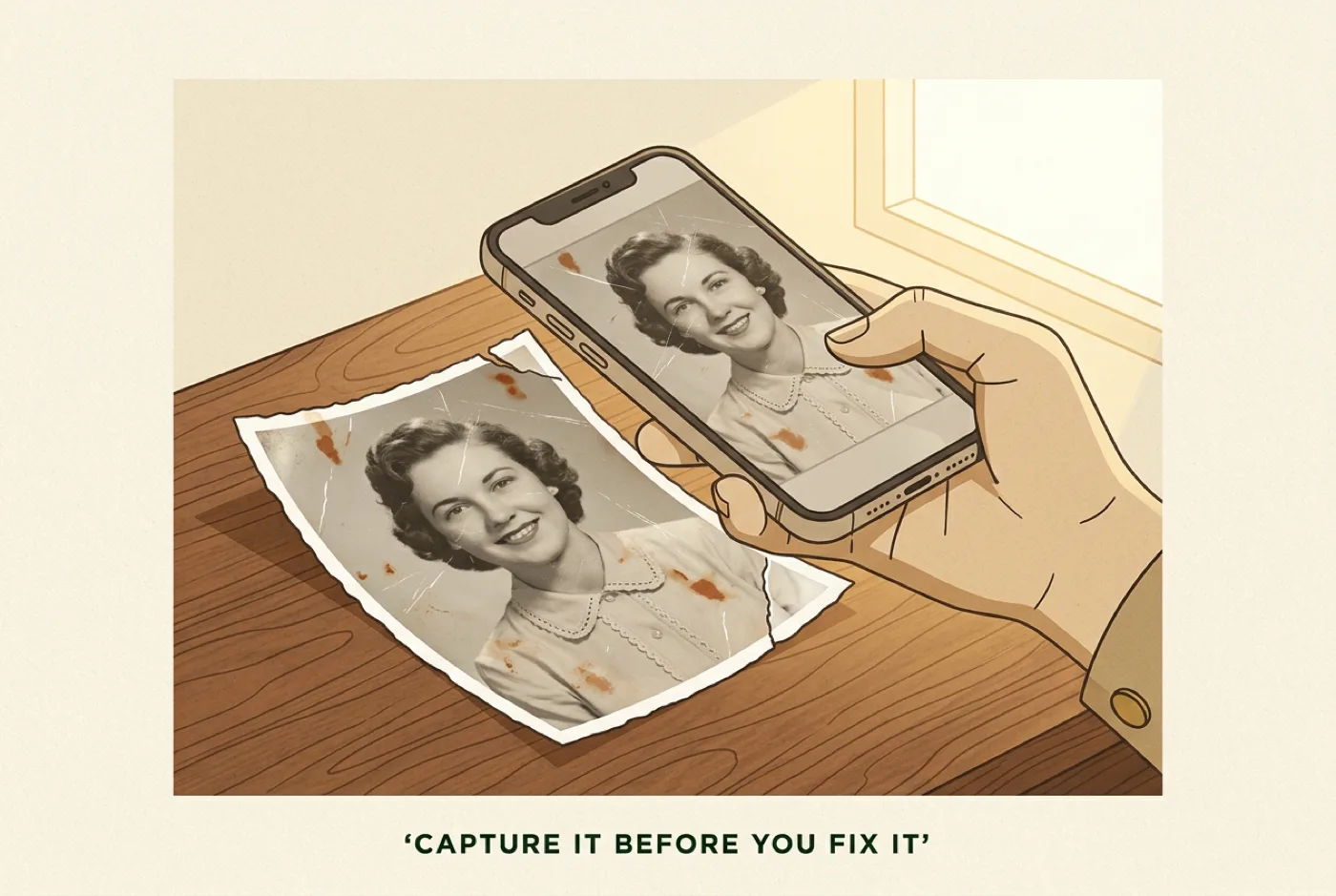
The verdict table
This is the reference the rest of the article unpacks. "Verdict" answers the question for the picture, meaning a clean restored copy, which is what most people are asking for. The physical print is a separate question, covered in the last two columns.
| Damage | Can the picture be saved? | Protect the print | What AI restoration does | Call a professional when |
|---|---|---|---|---|
| Fading, yellowing | Yes, routinely | Store it dark, cool, and dry | Contrast and color come back in one pass | The print itself is an heirloom worth treating |
| Scratches, dust, creases | Yes, routinely | Stop wiping it clean; grit scratches | Removes them cleanly; a deep crease across a face deserves a careful look at the result | Rarely needed |
| Tears, missing corners | Yes, with caveats | Keep every fragment; never use tape | Closes tear lines invisibly; missing areas get invented, so check any face near the gap | You want the paper itself mended |
| Water damage | Usually, if you act fast | Dry or freeze within 48 hours; protocol below | Lifts tide marks and staining once the print is dry and captured | A soaked box of heirlooms, or prints stuck together |
| Mold | Often | Isolate it; handle with a mask, outdoors | Removes spots from the copy the way it removes scratches | Active mold on something irreplaceable |
| Stuck together, stuck to glass | Sometimes | Do not peel; capture through the glass | Cleans glare and glass texture out of a careful capture | Separation is needed; that is always conservator work |
| Fire, heat | Partly | Handle char gently, on a rigid support; it crumbles | Clears smoke film and scorched edges; burned-away emulsion is gone | Badly charred originals |
| Blur, soft focus | Partly | Nothing to do physically | Sharpens mild softness well; heavy blur comes back as invented detail | You want the lost detail repainted by hand |
| Silver mirroring (metallic sheen on dark areas) | Yes, at capture time | Angle the light when you capture, until the sheen drops away | Cleans the remaining haze from a good capture | You want the object itself treated |
| Ink, tape, adhesive stains | Digitally, yes | Skip solvents and erasers | Lifts the marks out of the copy; the physical stain stays | Tape must come off the original |
"AI restoration" here means modern one-tap tools, ours or anyone's decent
one. By "professional" I mean either a human retoucher working on the
digital copy or a photograph conservator treating the object itself.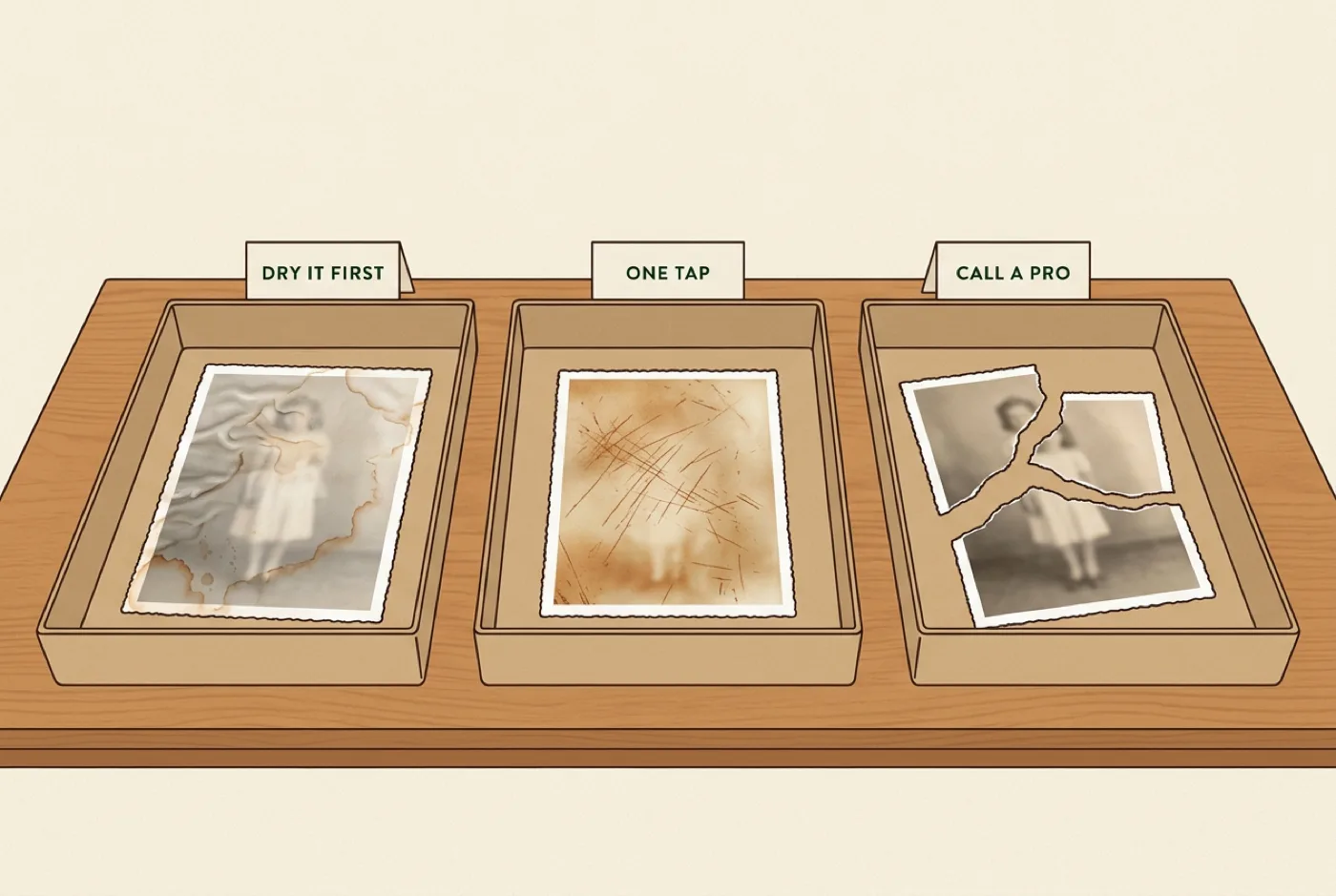
Can faded photos be restored?
Fading is the most common complaint, and it happens to be the easiest to fix. Color prints from the 1960s through the 1990s were made with dyes that age at different speeds, even in the dark, so the whole picture drifts warm and washes out. Black and white prints are chemically tougher; when they yellow, the paper and leftover processing chemicals are usually to blame.
Digitally this is the friendliest case. The picture is still all there,
just compressed into a narrow, murky range, and restoration re-stretches
tone and rebalances color in one pass. A print faded almost to blank is a
different job. So little survives that the tool has to reconstruct most
of the picture, and the result, however handsome, is partly a guess. You
can see what a routine fade fix looks like on the
restore old photos page, or
below.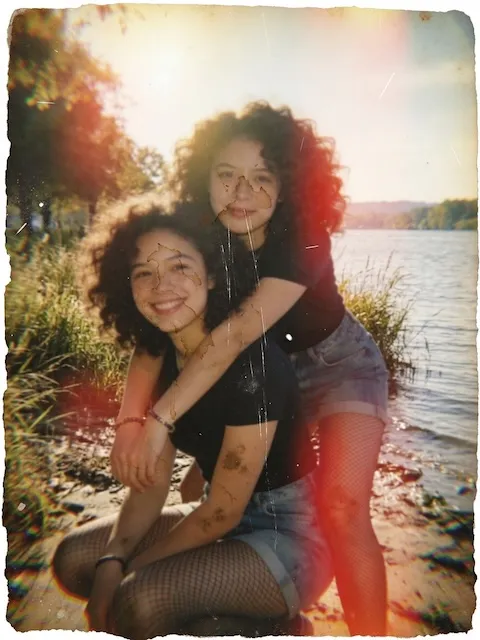

Can torn or scratched photos be repaired?
The one physical rule that matters is to never use tape. Its adhesive sinks into the paper, stains it, and takes slow conservator work to remove. Keep every fragment, including the tiny ones, flat in a paper envelope, and capture the pieces laid together.
Digitally, a tear is a thin line of missing information, and modern models close it invisibly, the same way they remove scratches. A missing corner is a different job. The model fills the hole with whatever plausibly belongs there, which works out when the hole held sky or a wall. When it held a face, the model invents someone who was never in the photo. We wrote up how those guesses work, with the research linked, if you want the deep end.
Can water-damaged photos be saved?
Usually, yes, and this is the one damage where hours matter. Conservation guidance is unanimous on the deadline: mold can start growing on wet photographs within about 48 hours, so everything below happens inside that window.
- Get the photos out of the water and somewhere cool and dry.
- If they are muddy, rinse them gently in clean, cool water. Do not scrub the image side.
- Do not pull apart stacks that are stuck together; wet emulsion peels off with its neighbor. Separate only what parts willingly.
- Air dry them flat, in a single layer, image side up, on paper towels or clean cloth. A fan helps if it is aimed past the prints. Keep them out of direct sun and away from heat.
- More photos than you can dry in time? Freeze the rest: interleave with wax or freezer paper, bag them, and thaw small batches later, at your convenience.
- Daguerreotypes, ambrotypes, tintypes, and glass negatives are the exception. Skip the soaking and freezing and hand them to a conservator.
This protocol is condensed from the Northeast Document Conservation Center's emergency salvage leaflet for wet photographs and the National Park Service's disaster guidance; both are worth reading in full if you are standing in front of a wet box right now.
Once the prints are dry, capture them and let software take over. Tide
marks and staining clean up well. Where water dissolved the emulsion
outright, the picture in that area is gone, and anything a tool puts
there is invention.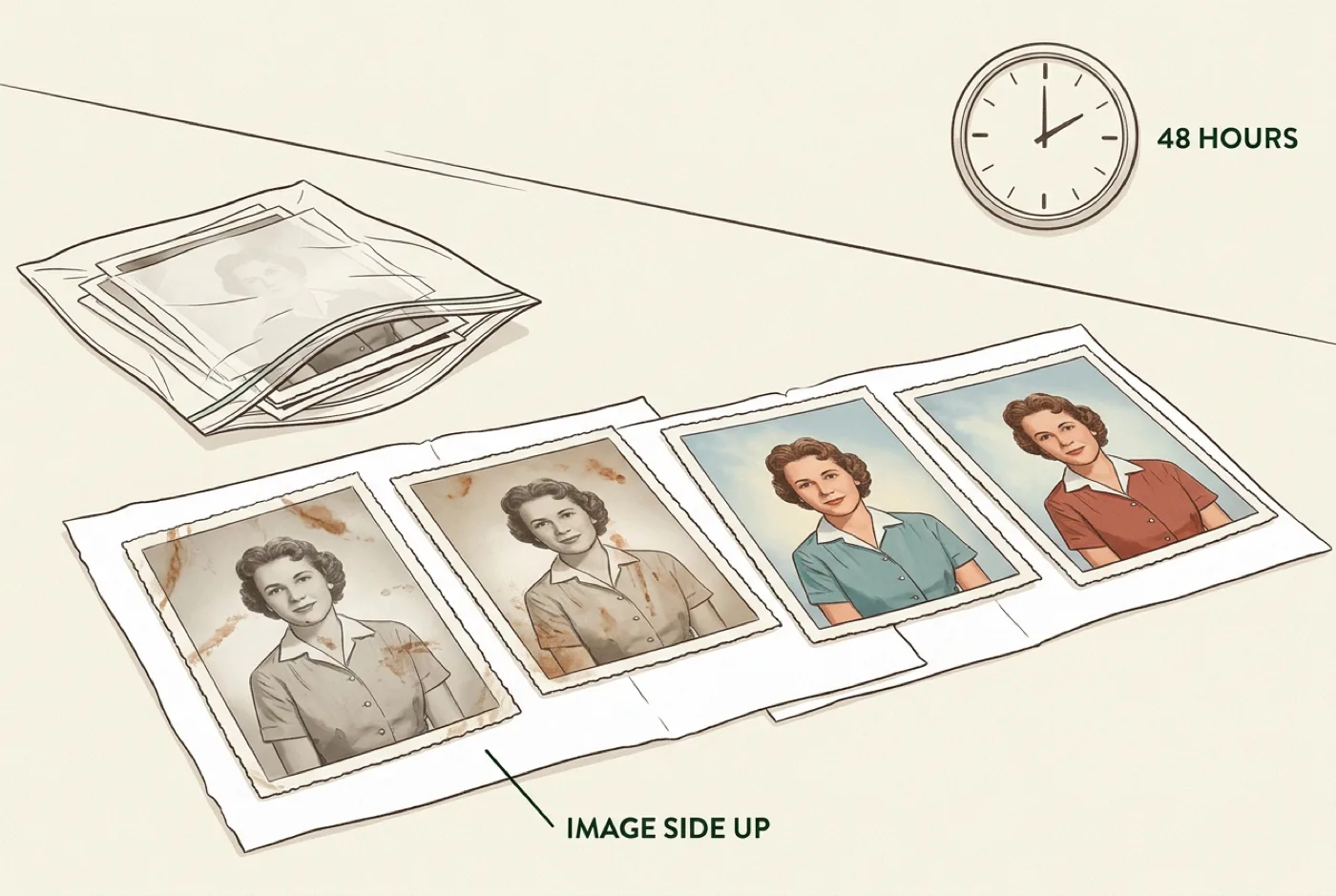
What about mold, fire, or photos stuck to glass?
Treat mold as a health problem first. Isolate moldy prints from the rest of the collection, because spores travel, and handle them outdoors wearing a mask. Let damp mold dry completely before brushing it off, gently, away from you. In the digital copy, mold spots lift out the same way scratches do. Active mold on something irreplaceable is a conservator call.
Fire is a boundary case. Charred paper crumbles, so move it on a rigid support and handle it as little as possible. The smoke film that dulls survivors cleans up surprisingly well, while the areas the fire consumed are simply absent, and the invention caveat applies to them in full.
Photos stuck to glass happen when a framed print gets damp and then dries, bonding the gelatin to the pane. The fix is to capture the photo through the glass. Angle your light until the reflections fall away, shoot square-on, and software can remove the glass texture afterward. Getting the print off the pane physically is conservator work, so leave the prying and soaking to them.
What nothing can bring back
An honest guide has to say where the line sits. Some losses are past the reach of every tool and every professional:
- A face that is fully gone. If flaked emulsion or a burn took the whole face, the model draws a stranger. It has no way to reach the person who was there; that information left the world.
- Detail the film never recorded. A sign that is four gray blobs stays four gray blobs however sharp its edges get. Sharpening adds confidence to the shapes without adding knowledge of what they said.
- The real colors behind black and white. Colorization is educated inference. Skies and skin usually land close. The color of a dress or a car went unrecorded by the film, so any answer there is a guess.
Every restored photo is a mixture of the two. A good tool is honest about
which parts were recovered and which were filled in, and either way you
keep the original print and the raw capture. We publish real examples of
both outcomes, graded against ourselves, on our
methodology page.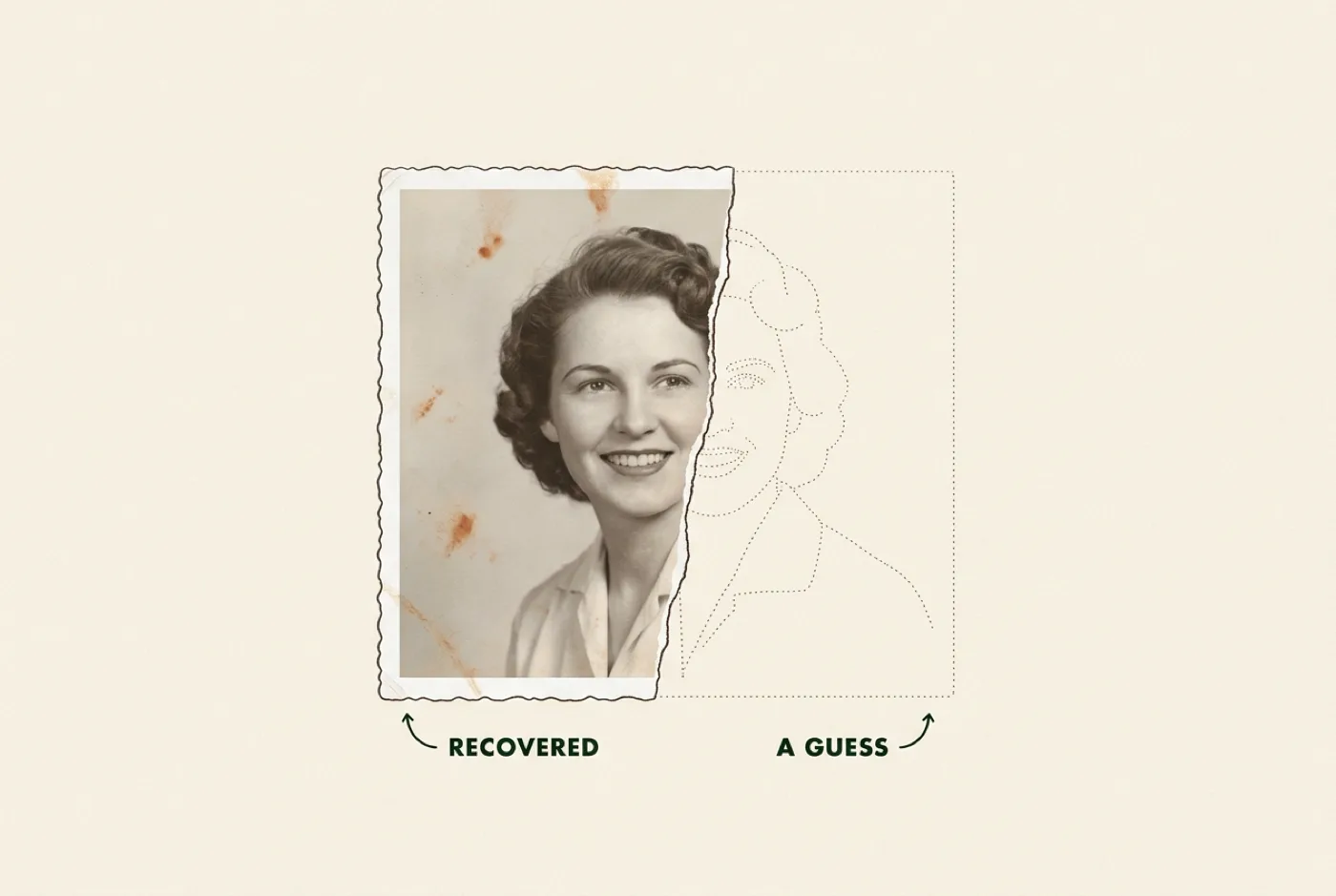
App, human retoucher, or conservator?
The three options are different purchases. An app repairs the picture in seconds for pennies. Hiring a human retoucher buys judgment on top, typically $29-45 per photo at mainstream services and well past $200 when the reconstruction is severe, while a conservator is someone you pay to treat the physical object, quoted per treatment.
When the value is in the picture, go digital first; an app pass costs
pennies and tells you within seconds how hard your case is. Talk to a
conservator before anyone touches an object you care about in itself.
Human retouchers cover the middle ground, where the picture matters and
the damage has defeated the app. No download. Photos are deleted from our servers after processing.
Common questions
Can very old photos be restored?
Damage type matters far more than age. An 1890s print that stayed dry restores as well as a 1980s one. The exceptions are cased photographs (daguerreotypes, ambrotypes, tintypes), which need specialist physical handling, though a clean capture of one restores fine.
Can old photos be restored without the negative?
Yes. Modern restoration works from the print itself; a good capture of the print is the only input needed. A surviving negative simply offers a higher-quality starting point.
How much does photo restoration cost?
Apps cost pennies to a few dollars per photo. Human digital retouching runs roughly $29-45 per photo for typical damage at mainstream services, more for severe reconstruction. Conservation of the physical print is quoted per object.
Does restoring a photo damage the original?
Digital restoration never touches the original; it produces a new file from a capture. Keep the print stored dark, cool, and dry afterward, and keep the unedited capture too.
Sources
- Northeast Document Conservation Center, Preservation Leaflet 3.7: Emergency Salvage of Wet Photographs. nedcc.org
- National Park Service, Preservation Matters: Disasters - Saving Wet Photographs. nps.gov
- University of Texas at Austin iSchool, Emergency Salvage of Family Treasures. ischool.utexas.edu